
Human Design
Human Design Centers Explained: All 9 Energy Centers and What They Mean
The 9 energy centers in Human Design govern everything from communication to survival instincts, emotional processing, and life direction. Defined centers broadcast consistent energy; undefined centers absorb and amplify energy from others. Understanding your centers is the foundation of deconditioning.
Published on 2026-04-17·10 min read·83 views·The OriCode Team
Quick Answer
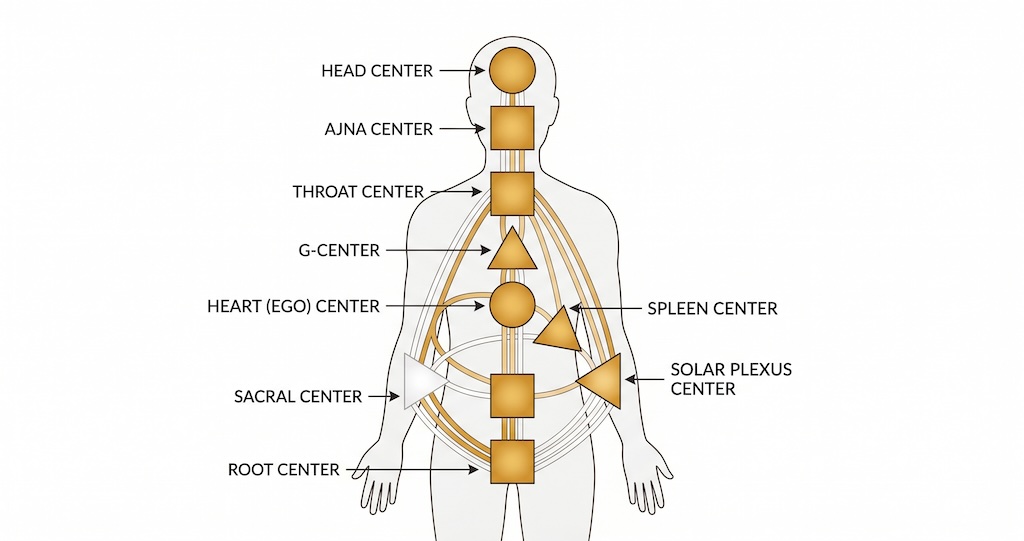
Human Design has 9 energy centers: Head, Ajna, Throat, G Center (Identity), Heart/Will, Solar Plexus, Spleen, Sacral, and Root. Each center governs a specific domain of life — from pressure and communication to survival instincts and life direction. Defined (colored) centers function consistently. Undefined (white) centers are receptive and amplify whatever energy enters them from outside.
What Are Human Design Centers?
The nine energy centers in Human Design are derived from the Hindu Chakra system but with key differences. Unlike chakras, Human Design centers can be defined (colored in your chart) or undefined/open (white). This distinction fundamentally shapes how you experience each center's themes throughout your life.
A defined center has consistent, reliable energy in that domain. You generate this energy independently and broadcast it to others. A defined Solar Plexus, for example, means your emotional waves are your own — they come from within.
An undefined center receives and amplifies energy from others. You don't generate this energy consistently on your own, but when you're around someone with the corresponding defined center, you pick up their energy and often feel it more intensely than they do.
This dynamic — defined centers broadcasting, undefined centers absorbing — is the core of what Human Design calls conditioning: the way your environment and the people in it shape how you think, feel, and make decisions.
The 9 Centers: Complete Guide
1. Head Center (Crown)
Theme: Inspiration, mental pressure, questions
The Head Center is where mental pressure originates. It generates questions, inspiration, and the urge to make sense of existence. This center has nothing to do with decision-making — its job is to generate questions and inspiration to pass to the Ajna.
Defined Head Center: You experience consistent mental pressure and inspiration. You have a reliable, predictable way of generating questions and ideas. The risk: you may pressure others to resolve your questions too.
Undefined Head Center: You absorb mental pressure from your environment and from people with defined Head Centers. You may find yourself wrestling with questions that aren't really yours, trying to resolve pressure that isn't your problem to solve.
Not-self question: "Am I trying to answer questions that aren't mine to answer?"
2. Ajna Center (Mind)
Theme: Conceptualization, analysis, certainty/uncertainty
The Ajna processes what the Head sends — it's the center of mental processing, analysis, and the formation of opinions and concepts. Importantly, the mind (Head + Ajna) is not a decision-making authority in Human Design. It's for processing and communicating, not for choosing.
Defined Ajna: You have a fixed, consistent way of thinking and processing. You form reliable opinions and tend toward one mode of analysis (visual, conceptual, rational, etc.).
Undefined Ajna: You're mentally flexible and can hold multiple perspectives simultaneously. The shadow: you may feel pressure to sound certain when you're not, or to commit to opinions you haven't fully formed.
Not-self question: "Am I pretending to be certain when I'm not?"
3. Throat Center
Theme: Communication, action, manifestation
The Throat Center is the center of expression and action — it's how energy moves from internal to external. Everything in Human Design ultimately seeks to express through the Throat. This makes the Throat the most connected center in the chart.
Defined Throat: You have a consistent, reliable voice and way of communicating. People know what to expect from you verbally. Some defined Throat configurations come with an ability to attract attention and speak with authority.
Undefined Throat: Your communication style adapts to context and audience. The shadow: you may feel compelled to speak to get attention, or to fill silence. Talking to be seen rather than to express something real is the classic not-self pattern here.
Not-self question: "Am I speaking to get attention rather than because I have something real to say?"
4. G Center (Identity Center)
Theme: Self, direction, love
The G Center governs your sense of self, your love of life, and your life direction. It's the magnetic north of your chart — the center that orients you toward your purpose. The G Center is also where you receive the love and direction that comes to you when you're in correct environments and around correct people.
Defined G Center: You have a consistent sense of self and a fixed direction in life. People experience you as reliable, grounded, and directional.
Undefined G Center: Your sense of self is contextual — it shifts based on who you're with and where you are. This is not a flaw. It means you're designed to experience many different identities, directions, and expressions of love throughout your life. The shadow: constantly asking "who am I?" and "where am I going?" from a place of anxiety rather than curiosity.
Not-self question: "Am I trying to fix my identity instead of trusting that I'll find direction by being in the right place?"
5. Heart Center (Will Center / Ego Center)
Theme: Will, ego, self-worth, commitments, material world
The Heart Center is the seat of the ego, willpower, and material desires. It governs self-worth, promises, and the capacity to work hard for material goals. Only about 35% of people have a defined Heart Center.
Defined Heart Center: You have consistent willpower and a reliable sense of your own value. You can make promises and keep them. You have natural confidence in the material world. The risk: you may push your will onto others or overwork yourself without realizing it.
Undefined Heart Center: Your willpower is inconsistent — not a character flaw, but a design feature. When you're around defined Heart Center people, you feel their will and temporarily feel more motivated. The shadow: making promises you can't keep, or constantly trying to prove your worth.
Not-self question: "Am I trying to prove my worth, or do I already know I'm enough?"
6. Solar Plexus (Emotional Center)
Theme: Emotions, feelings, desires, spirituality
The Solar Plexus is one of the most significant centers in the chart. About 50% of people have it defined, and those people have emotional authority — meaning clarity only comes over time, in waves, never in a single moment.
Defined Solar Plexus: You live in emotional waves — highs and lows that cycle through regularly. You are never neutral. Your authority is to wait for emotional clarity before making significant decisions. The risk: acting at the peak of a wave (excitement) or trough (despair) rather than waiting for the calm.
Undefined Solar Plexus: You absorb and amplify the emotions of everyone around you. You feel others' feelings as if they were your own, often more intensely than the source person. The shadow: avoiding emotional confrontation to keep the peace, or making decisions while flooded with others' emotions.
Not-self question: "Am I avoiding necessary truth to keep the emotional environment comfortable?"
7. Spleen Center (Splenic Center)
Theme: Survival, intuition, health, fear, immune system
The Spleen is the oldest awareness center in Human Design — it operates in the present moment, governs survival instincts, and is the source of splenic authority for some people. Its messages are quiet, immediate, and don't repeat.
Defined Spleen: You have consistent, reliable access to in-the-moment intuition. You have a natural sense of what's healthy or not, safe or not, right or not — right now. The gift: you rarely need to second-guess yourself. The risk: ignoring the quiet knowing because the mind overrides it.
Undefined Spleen: You don't have a consistent immune or intuitive signal. You may hold onto things (jobs, relationships, environments) past their expiration date because you never got a clear "let go" signal. You may also be more physically sensitive and need to pay more attention to health signals.
Not-self question: "Am I holding onto something that I know is unhealthy simply because it feels familiar?"
8. Sacral Center
Theme: Life force, sexuality, work capacity, response
The Sacral Center is the most powerful motor in Human Design — it generates sustainable life force energy. Only Generators and Manifesting Generators have a defined Sacral Center, which is why they make up approximately 70% of humanity: they are here to work, to do, to create.
Defined Sacral (Generators/MGs only): You have virtually unlimited energy for what you respond to. The key word is respond — Sacral energy is activated by response, not initiation. A Generator who initiates from the mind rather than responding from the Sacral will feel exhausted and frustrated.
Undefined Sacral (Projectors, Manifestors, Reflectors): You do not have consistent access to Sacral energy. You can amplify others' Sacral energy and push past your limits when around Generators — but you will pay for it. Non-Sacral types need significantly more rest than Sacral types.
Not-self question (non-Sacral types): "Am I trying to match Generator work capacity and burning myself out?"
9. Root Center
Theme: Pressure, adrenaline, stress, drive to resolve
The Root Center is a pressure center and a motor. It generates the adrenaline-like pressure to get things done, to move, to resolve. When the pressure is correctly channeled, it produces healthy drive and focus.
Defined Root: You have consistent, predictable pressure. You can work steadily under stress without it destabilizing you. The risk: you may unconsciously apply your pressure to others who don't have defined Roots.
Undefined Root: You absorb pressure from your environment and may feel urgently driven to resolve things just to relieve the pressure — even when resolution isn't necessary or correct. Classic behavior: rushing through tasks, decisions, or conversations just to get out from under the pressure.
Not-self question: "Am I rushing this to escape pressure rather than because it's genuinely time to act?"
How to Read Your Centers
When you look at your Human Design chart, you'll see nine geometric shapes connected by lines. The colored shapes are your defined centers; the white ones are undefined.
Step 1: Note which centers are defined (colored). These are your consistent energies — what you broadcast to the world.
Step 2: Note which centers are undefined (white). These are your receptive areas — where you're conditioned by your environment and the people around you.
Step 3: For each undefined center, memorize the not-self question. These questions help you catch when you're operating from conditioning rather than your authentic self.
Step 4: Look at which defined centers are connected by colored channels (lines). These channels carry specific themes and gifts.
For a full analysis of how your defined and undefined centers interact with your authority and strategy, explore The OriCode's complete Human Design report.
Centers and the Human Design Types
Your type determines which centers are guaranteed to be defined or undefined:
| Type | Guaranteed Defined | Guaranteed Undefined |
|---|---|---|
| Generator | Sacral | — |
| Manifesting Generator | Sacral | — |
| Projector | — | Sacral |
| Manifestor | — | Sacral |
| Reflector | None (all open) | All (potentially) |
The Sacral Center is the most type-defining center. Its presence or absence determines whether you're a Sacral being (Generator/MG) or a non-Sacral being (Projector, Manifestor, Reflector).
For more on how your type shapes your experience, see:
- Human Design Generator guide
- Human Design Projector guide
- Human Design Manifestor guide
- Human Design Reflector guide
Frequently Asked Questions
What does it mean to have all centers defined? Very few people have all nine centers defined. Having all centers defined means you have consistent, fixed energy across all domains — you're highly self-contained and less open to conditioning from others. The flip side: you may be less adaptable and more set in your ways.
Can I improve my undefined centers? You don't "improve" undefined centers — they're designed to be receptive and fluid. What you can do is become aware of how your undefined centers are being conditioned, which allows you to consciously choose whether to act from that conditioned state or from your authentic authority.
Why do I feel other people's emotions so intensely? If you have an undefined Solar Plexus, you absorb and amplify the emotional states of people with defined Solar Plexus Centers. This is the most common reason empaths report feeling overwhelmed in social situations — they're literally carrying other people's emotional waves.
Is it better to have more defined centers? No. Neither defined nor undefined centers are superior. Defined centers provide consistent, reliable energy; undefined centers provide wisdom gained through experiencing many different versions of that energy. Both are needed.
What is the most important center in Human Design? The Sacral Center is arguably the most important because it determines your type (Generator vs. non-Sacral). But within your own chart, your defined centers are where your consistent gifts live, and your undefined centers show where you're most open to growth and wisdom.
How do centers relate to my Human Design authority? Your authority is determined by the specific combination of defined centers in your chart, in a hierarchy. Emotional authority comes from a defined Solar Plexus. Sacral authority comes from a defined Sacral without a defined Solar Plexus. Splenic authority comes from a defined Spleen without a defined Solar Plexus or Sacral. And so on down the hierarchy.
What does "open" mean vs. "undefined"? In modern Human Design, "open" and "undefined" are often used interchangeably, but technically "open" refers to centers with no gates activated at all. An undefined center may have some gates colored but not form a complete channel. Open centers are more completely receptive than undefined centers with some activations.