
Human Design
Human Design 4/1 Profile: The Opportunist Investigator (Traits, Relationships, Career)
The 4/1 profile (Opportunist Investigator) is the one Human Design profile with a fixed life path — it does not bend to circumstance the way other profiles do. Here is how Line 4's network wiring and Line 1's need for a solid foundation shape your relationships, your career, and the way opportunity actually reaches you.
Published on 2026-07-14·14 min read·20 views·The OriCode Team

Human Design 4/1 Profile: The Opportunist Investigator
If you have a 4/1 profile in Human Design and you have ever felt like your life runs on rails other people do not have — the same kind of work, the same kind of friends, the same path even when you try to change lanes — that is not a flaw in you. It is the profile working as designed. The 4/1 is the one profile in the system with a fixed path, and once you understand what "fixed" actually means, most of the frustration around it drops away.
Quick Answer: The 4/1 (Opportunist Investigator) is built from Line 4 (your conscious personality — you meet life through relationships and networks) and Line 1 (your unconscious design — you need a solid foundation of knowledge before you feel safe to act). It is the only profile that is neither Right Angle nor Left Angle; it sits in the middle as the "Juxtaposition" profile, which is why its path feels fixed rather than flexible. Opportunity reaches a 4/1 through trusted people, not cold outreach — and a 4/1 who has done their homework becomes a stabilizing anchor for everyone around them.
What Is the 4/1 Profile in Human Design?
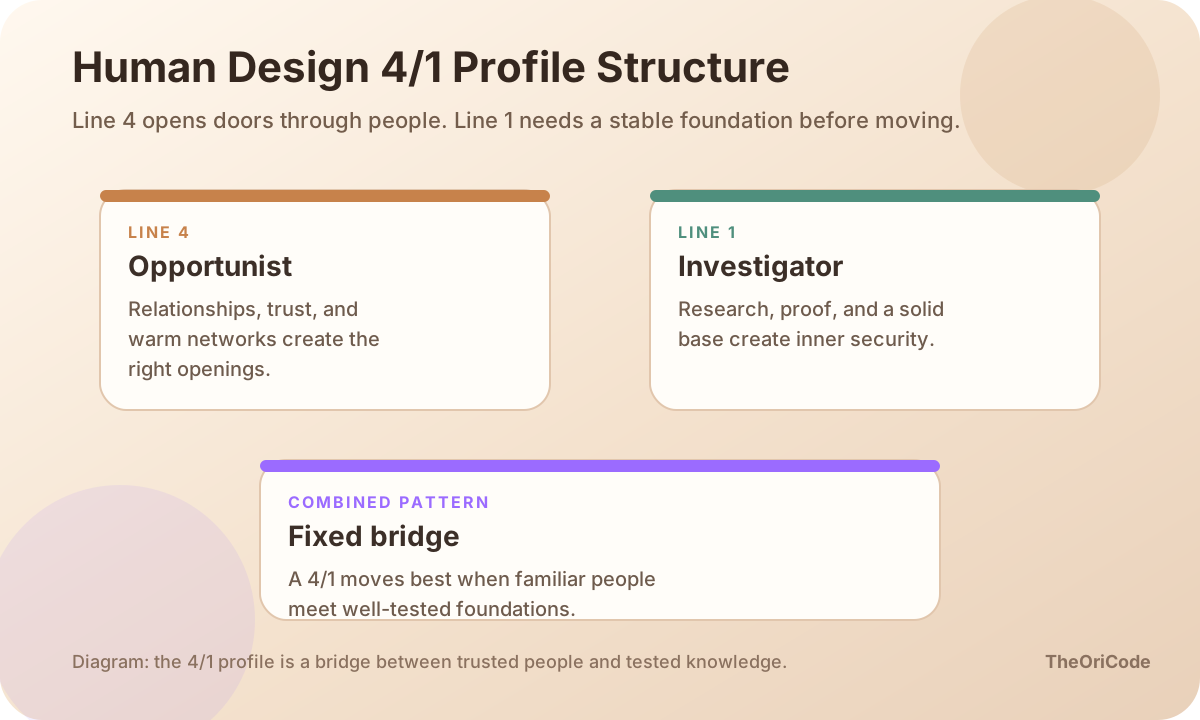
Diagram: the 4/1 profile combines Line 4's relationship network with Line 1's need for a reliable foundation. This is why the profile can look social on the outside and deeply research-driven underneath.
Your Human Design profile is the two-number code near the top of your chart — 1/3, 2/4, 3/5, and so on. The numbers come from the six lines of the I Ching hexagram, and they describe how you are here to live, layered on top of your Type and Authority.
The first number is conscious — the role you know you are playing, the way you experience yourself. The second number is unconscious — the role other people see in you, running in the background whether you notice it or not.
For a 4/1, that means:
- Line 4 — the Opportunist (conscious). You lead with relationships. Your influence, your work, and your opportunities move through a web of people who already know and trust you.
- Line 1 — the Investigator (unconscious). Underneath, you need to know things deeply. Security comes from having a foundation solid enough to stand on before you commit.
Why the 4/1 Is the Only "Fixed" Profile
This is the part almost every short profile description skips, and it is the single most important thing to understand about being a 4/1.
Most profiles fall into one of two life orientations. Right Angle profiles (like 1/3, 2/4, and 3/5) are here for their own personal journey — self-focused, learning through their own experience. Left Angle profiles (like 5/2 and 6/3) are here for a more collective, transpersonal path that plays out through other people.
The 4/1 belongs to neither. It is the single Juxtaposition profile — the hinge between the personal and the transpersonal — and the classical description of that position is a fixed fate. Where other profiles adapt and re-route depending on who and what shows up, the 4/1 tends to arrive with the script already written. You are less swayed by outside pressure, harder to talk out of your direction, and slower to reinvent yourself. That can feel like being stuck. Lived well, it is the opposite: you become the fixed point other people orient around.
The old teaching image for this is an anchor. An anchor does not drift with the current, and because it holds, the boats around it hold too. When a 4/1 is grounded in what they know and rooted in the people they trust, the whole system near them gets steadier.
Line 4: The Opportunist (Your Conscious Personality)
Line 4 is a relationship line. Its home is the network — the friends, colleagues, former classmates, and long-standing contacts who form the fabric of your life.
Opportunity Comes Through People, Not Cold Outreach
Here is the practical rule that changes everything for a 4/1: your next job, your next client, your next relationship almost never comes from a cold application or a stranger. It comes from someone who already knows you.
This is not a preference. It is wiring. When a Line 4 person tries to force opportunity through channels built for strangers — mass-applying to job boards, cold-DMing, "hustling" a room full of people they have never met — it tends to stall, drain them, and produce worse results than a single warm introduction would. The design runs on trust that already exists. A quiet word from a friend who says "you should talk to this person" will outperform a hundred cold messages.
The flip side is that a 4/1 should never burn a bridge casually. Your network is your opportunity pipeline, so tending it — staying in touch, being reliable, keeping the door open — is not networking in the LinkedIn sense. It is closer to maintenance of the ground you walk on.
The Bonds-and-Betrayals Wiring
Line 4 is sometimes described through "bonds and betrayals," and it can sound dramatic, but the everyday version is simple. A 4/1 forms deep, lasting bonds and does not let go of them easily. That loyalty is a gift and a trap.
The trap: because losing a connection feels genuinely threatening, a 4/1 can stay too long in a job, a friendship, or a relationship that has clearly stopped working — not out of weakness, but because the design fears the gap more than the discomfort. Naming that fear is usually enough to loosen it. You are allowed to close a chapter before the next one is fully guaranteed. The network regenerates; the anchor does not sink because one line was cut.
Line 1: The Investigator (Your Unconscious Design)
If Line 4 is how you meet the world, Line 1 is what you are quietly doing underneath: digging until you hit bedrock.
Security Comes From a Foundation
Line 1 needs to know. Not skim — know. Before a 1 feels safe to act, it wants the underlying facts, the mechanics, the "why" beneath the "what." Give a 4/1 a new field and they will instinctively read, research, and study their way to a base solid enough to stand on. Once that foundation is in place, the confidence is unshakable, because it is built on genuine understanding rather than borrowed opinion.
Other people rarely see this happening. Line 1 is unconscious for a 4/1, so the world mostly meets the friendly, connected Line 4 surface and misses the serious research going on below it. The depth is real; it is just not on display.
The Analysis-Paralysis Trap
The shadow of Line 1 is using research as a place to hide. "I am not ready yet, I need to know more" can become a permanent condition — a way to avoid the exposure of acting before you feel fully prepared. There is a related anxiety Line 1 people describe: dropped into an unfamiliar situation, they feel like they need ten answers ready before they will say a word.
The correction is not to abandon the foundation — you genuinely need it — but to notice when "one more book" has become an excuse. A 4/1 does their best work when the deep foundation of Line 1 is delivered through the trusted relationships of Line 4: you learn something thoroughly, then you share it with the people who already trust you. Study without a network to carry it stays stuck in your head. A network without depth behind it makes you just another friendly voice. Together, they are the whole point of the profile.
The 4/1 in Real Life: What This Looks Like Day-to-Day
In Relationships
A 4/1 tends to meet partners through their existing circle — a friend of a friend, someone from the same community, a slow build rather than a lightning strike with a stranger. Once in, they are loyal to a fault and slow to leave. The growth edge is the same as the career one: learning that ending something that no longer fits is not a betrayal of your own loyalty. Choose partners who value that steadiness rather than reading it as rigidity.
In Career and Work
The 4/1 is one of the most naturally stable profiles in the working world. You are not built to job-hop every eighteen months or reinvent your whole identity each year. You are built to go deep, build a foundation of real expertise, and let that expertise travel through people who vouch for you. The career mistakes to watch for are the two shadows meeting at once: cold-outreaching instead of using your network (fighting Line 4), and endlessly preparing instead of shipping (hiding in Line 1). Fix those two and the profile is quietly formidable.
If you want that translated into an actual plan, the 90-Day Career & Side-Hustle Direction Report maps your chart into concrete, foundation-first decisions — one yes-or-no at a time, in the order a 4/1 actually moves.
The Fixed-Anchor Strength
When you stop fighting the fixed path and start trusting it, the 4/1 becomes the person others rely on to hold steady — the colleague who does not panic, the friend whose direction does not wobble with every trend, the steady center of a shifting room. That is not a small thing. Most people spend their lives searching for solid ground. A grounded 4/1 is the solid ground.
Some of the athletes and public figures most often cited as 4/1 examples — Cristiano Ronaldo, Shohei Ohtani — fit that picture of a relentless, foundation-first operator who barely deviates from their lane. Treat those labels loosely, though: profiles depend on an exact birth time, and most celebrity birth times are unverified, so the examples are illustrations of the pattern, not proof.
The 4/1 Profile Across the Five Types
Your profile describes how you live, but your Human Design Type and Authority decide what powers your decisions. The 4/1 pattern expresses a little differently depending on your Type:
- Generator / Manifesting Generator: The most natural fit. Let your Sacral respond to the opportunities your network brings you instead of chasing cold leads.
- Projector: Wait for the genuine invitation and build your Line 1 foundation. Your recognition will come through people who already know your work — guard your energy while it does.
- Manifestor: You can initiate within your network, but honor your Strategy: inform the key people before you act, so your bonds stay intact.
- Reflector: Give network opportunities a full lunar cycle before you commit. Your Line 1 depth and a month of clarity are a powerful combination.
Common Misconceptions About the 4/1 Profile
"Fixed means I'm stuck." Fixed means consistent, not trapped. You change more slowly and get pulled off course less easily than other profiles — that is a stability most people would envy, not a life sentence.
"I'm an extrovert because I'm so relational." Line 4 is about depth of connection, not volume of it. Many 4/1s are quiet researchers who happen to have a small, deep, high-trust network. The friendliness is real; it does not require a crowd.
"I should be networking harder." Not in the hustle sense. Your design runs on existing trust, so tending a handful of real relationships beats broadcasting to strangers every time.
"I need to pick one thing and stop studying." The opposite. Line 1's foundation is your edge. The only correction is to make sure the studying eventually turns into something you share, not a place you hide.
Our Take: Why "Fixed Fate" Is the 4/1's Advantage, Not Its Cage
Most Human Design content treats every profile as infinitely improvable — do the work, deconditioning happens, and you become endlessly adaptable. For eleven of the twelve profiles, that framing is roughly fine. For the 4/1, it quietly misleads, and after writing up the profile series here — the 1/3, the 2/4, the 3/5 — the 4/1 is the one where "just stay flexible" is actively bad advice.
Here is the pattern we keep seeing. A 4/1 reads generic self-improvement material that prizes adaptability, pivoting, and constant reinvention, and concludes something is wrong with them because they cannot pivot the way the content says they should. They try to force flexibility they are not built for, and they end up anxious and scattered — a foundation-first, network-loyal person cosplaying as a serial reinventor. The fix is not more flexibility. It is permission to be fixed: go deep in one direction, protect your real relationships, and let the consistency compound.
There is a second blind spot, and it is where TheOriCode sits. The Western Human Design conversation talks about "fixed fate" almost apologetically, as if a set path were a limitation to overcome. Eastern systems read the same signal as strength. In BaZi, stable, well-rooted charts — the ones with a strong, grounded Day Master and clear structure — are not seen as boring or stuck; they are seen as reliable, the charts that hold up under pressure while flashier ones burn out. Purple Star Astrology has an almost identical image to the anchor: the stabilizing star that keeps a whole chart from scattering. When you cross-reference the two traditions, the 4/1's "fixed fate" stops looking like a Western consolation prize and starts looking like what several of the world's oldest systems independently call an asset: a life that does not blow around in the wind.
The practical takeaway is small and specific. Stop benchmarking yourself against the reinvent-yourself-every-year crowd — that is not your game, and losing at someone else's game is not the same as losing. Pick a direction you can go deep on. Invest in a handful of relationships you would still want in ten years. Turn your research into something you actually put in front of those people. Do that, and the exact quality that made you feel out of step — the refusal to drift — becomes the reason others build around you.
Related reading: Human Design Gates Explained
FAQ: Human Design 4/1 Profile
What does the 4/1 profile mean in Human Design? It means your conscious personality runs on Line 4 (the Opportunist — you meet life and opportunity through relationships and networks) and your unconscious design runs on Line 1 (the Investigator — you need a deep foundation of knowledge before you feel secure acting). It is the only profile with a fixed rather than flexible life path.
Is the 4/1 a rare profile? It is one of the less common profiles, though exact population figures vary between sources and are not reliable, so treat any hard percentage you see with caution. What makes it stand out is less about how rare it is and more about its position: the 4/1 is the single Juxtaposition profile, the only one that is neither Right Angle nor Left Angle.
Why does the 4/1 feel like it has a "fixed" life? Because it sits between the two main life orientations rather than inside either one. The classical description of that position is a fixed fate: a 4/1 is less swayed by circumstance, harder to redirect, and more consistent over time than other profiles. Handled well, that reads as stability and reliability, not limitation.
What careers suit a 4/1 profile? Anything that rewards deep expertise delivered through trusted relationships: specialists, consultants, researchers, long-tenure roles, and work you reach through referral rather than cold applications. Avoid environments that demand constant reinvention or reward cold self-promotion over genuine depth.
How does a 4/1 find opportunities? Through people who already know and trust them. Warm introductions, existing networks, and long-standing contacts work far better for a 4/1 than cold outreach, job boards, or broadcasting to strangers. Your network is your opportunity pipeline.
Can ChatGPT explain my 4/1 profile accurately? It can help you interpret it once you feed it your real chart, but it tends to default to generic profile descriptions and misses the fixed-fate distinction that defines the 4/1. Generate your actual chart first, then use focused questions — our ChatGPT Human Design prompts guide shows how.
Get Your Full Human Design Reading
The 4/1 profile is only one line of your chart. To see how it interacts with your Type, Authority, and Centers, you need your full design. Generate your free Human Design chart in under a minute, then read this profile alongside your other placements.
When you are ready to turn all of that into an actual plan — which direction to go deep on, which opportunities to say yes to — the 90-Day Career & Side-Hustle Direction Report reads your chart into concrete, decision-by-decision guidance built for exactly the foundation-first way a 4/1 works. And if you want a free starting point first, the Core Blueprint translates your chart into a plain-English read on how you are wired to decide.