
Human Design
Human Design vs MBTI: Which One to Use for Which Decision
Skip the which-is-real debate. MBTI names how you think and communicate; Human Design works as a decision and timing lens. A use-case comparison with a side-by-side table, real situations, and an honest note on limits.
Published on 2026-06-29·8 min read·56 views·The OriCode Team
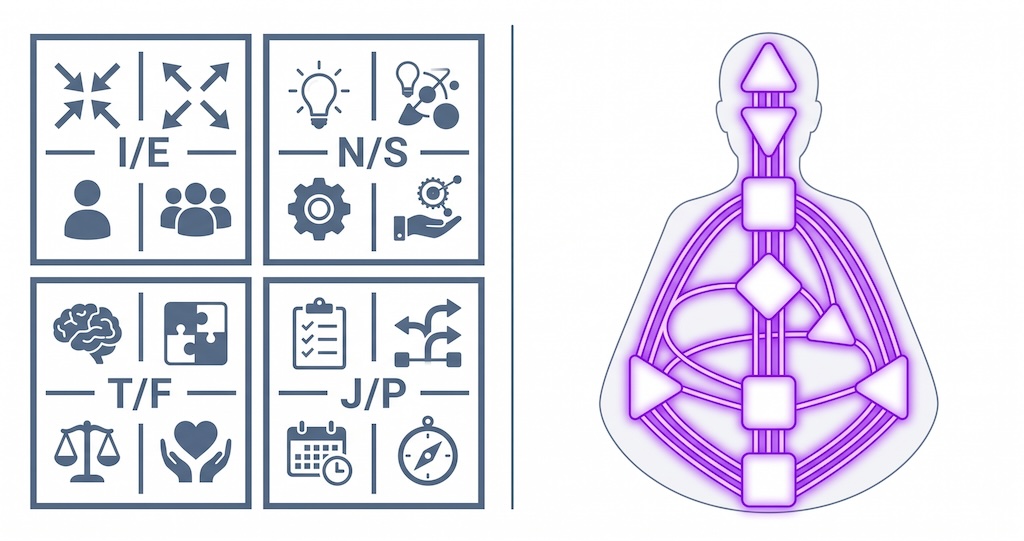
Most "Human Design vs MBTI" articles spend their whole length arguing which system is more real. That argument goes nowhere, because the two tools were built for different jobs. This guide skips the philosophy fight and answers the question people actually have: which one do I reach for, and when?
The short version: MBTI describes your preference patterns, how you tend to think and communicate. Human Design works best as a decision and timing lens, how you decide and where your energy should go. Split them by use case and the rivalry disappears.
Quick Answer
MBTI sorts you into one of 16 types from a self-report quiz and is good for naming how you communicate. Human Design is calculated from your birth date, time, and location, and is most useful as a decision-support tool through your Strategy and Authority. Use MBTI to talk about yourself with other people. Use Human Design when you are stuck on a real choice and your head keeps going in circles.
Two Tools, Two Jobs
Think of MBTI as a vocabulary and Human Design as a procedure.
MBTI gives you words. "I am an introvert, I need quiet to recharge." "I prefer concrete plans over open-ended brainstorming." Those sentences are genuinely useful in meetings, in relationships, and in email tone. They describe a preference pattern that is fairly stable across normal weeks.
Human Design gives you a procedure for deciding. It calculates one of 5 Energy Types and assigns an Inner Authority, a body-based rule for how you are meant to commit. It does not tell you what to choose. It tells you how to check whether a choice is actually yours.
If you are new to the type structure, our guide to the 5 Human Design Types walks through each one, and the Human Design Authority guide explains the body-based decision rules in plain language.
Side-by-Side Comparison
| Dimension | MBTI | Human Design |
|---|---|---|
| Input | Self-report questionnaire (~90 questions) | Birth date, time, and location |
| Output | 1 of 16 four-letter types | 1 of 5 Energy Types, plus Authority, Profile, Centers |
| What it describes | Cognitive preferences and communication style | A decision procedure and energy map |
| Best used for | Naming how you think and talk | Working through a specific decision |
| Stability over time | Can shift with mood, life stage, self-image | Fixed at birth, does not change |
| Time to learn basics | About 30 minutes | A few hours |
| Peer-reviewed validation | No, popular but disputed reliability | No, esoteric framework |
| Free chart or test | Yes (16personalities, truity) | Yes (TheOriCode) |
The row that matters most is "What it describes." One names a preference, the other runs a procedure.
A Job Offer: Watch the Split in Action
Say you get an offer. Better title, more money, longer commute, a manager you are not sure about.
MBTI can describe how you will process this. An INTJ will want a spreadsheet and a five-year projection. An ESFP will weigh how the office feels and who they will work beside. Useful self-awareness, but it does not resolve the decision. It just names the style you will use to agonize over it.
Human Design steps in exactly here. Your Authority is a rule for the moment of commitment. A Generator checks the gut response in the body when the offer is named out loud, a clear yes or a flat nothing. An Emotional Authority waits through a wave across a few days, because the feeling at hour one and the feeling at day three are different data points. A Projector watches for a real invitation rather than chasing the role.
This is the bridge a lot of readers need. When MBTI describes your decision style but you are still frozen, you are usually deciding from your head instead of your Authority. We wrote a whole piece on that loop in why am I so indecisive, and the Human Design half is the part that gets you unstuck.
A Hard Relationship Choice
Now a heavier one. You are deciding whether to stay in a relationship that is comfortable but quietly draining.
MBTI gives you language for the friction. "I am a Thinker, they are a Feeler, so we argue about whether I am being cold." Worth naming, but that axis is about how you justify a choice, not whether the choice is right for your energy.
Human Design reframes it as an energy question. Are your undefined Centers picking up their moods and labeling them as yours? Does your Authority give a consistent yes across weeks, or only when you are near them and amplifying their energy? Those questions often surface the thing MBTI politely skips.
If you want to run both lenses on the patterns you keep repeating, our relationship patterns quiz is built for that cross-check, MBTI for communication style, Human Design for whose energy you are actually carrying.
Team Communication
This is the one case where MBTI usually wins outright. When a whole team knows their types, you get a shared shorthand fast. "Give me the agenda before the meeting, I am a J." "Let me think out loud, that is how I process." That vocabulary smooths daily friction, and MBTI earns its decades of corporate use right here.
Human Design can layer on top for energy management, who initiates well, who needs to respond rather than push, who reads the room and should be asked rather than assigned. But for plain communication vocabulary across a group, MBTI is faster to teach. Use the right tool for the job.
Loose Type Correlations, With a Warning
People always ask whether their MBTI type predicts their Human Design type. There is no official mapping. From community charts, loose tendencies show up:
- Manifestors (~9%) often skew toward ENTJ, ESTJ, ENFJ, the "I decided, here is the heads up" energy. Read more in the Manifestor guide.
- Generators (~37%) often skew toward ISTJ, ISFJ, ESTP, ESFJ, the gut-response builders.
- Manifesting Generators (~33%) often skew toward ENTP, ENFP, ESFP, the multi-track fast movers.
- Projectors (~20%) often skew toward INFJ, INTJ, INTP, INFP, the system-seers.
- Reflectors (~1%) often skew toward INFP, ISFP, INFJ, the environment-sensitive mirrors.
Treat these as starting hypotheses, not predictions. Two ENFPs born on different days will have different charts, so run the actual chart rather than guess from your four letters.
Profile Nuance: Where MBTI Has No Equivalent
Here is something MBTI simply does not have. Two people can share an MBTI type and still operate on completely different growth tracks, and Human Design Profiles are where you see it.
A 1/3 Profile learns by digging into foundations and then through trial and error, bumping into things and adjusting. That is a specific life rhythm with no MBTI counterpart, shown in our 1/3 Profile guide. When MBTI feels too flat to explain why two ISTJs live such different lives, the Profile layer is usually the missing piece.
The Honest Limits
Neither system is peer-reviewed. MBTI has wide corporate adoption and disputed test-retest reliability, which is why you can get different letters six months apart. Human Design is an esoteric framework synthesized from the I Ching, astrology, and the chakra system, with no controlled studies behind it.
So read both as self-reflection tools, not as clinical instruments. The value is in the questions they make you ask. A chart is decision support, a structured way to slow down and check a choice against your own wiring. It is not a forecast of what will happen to you.
How to Actually Use Both
- Run both. Take a free MBTI quiz, and pull a chart with the free Human Design chart calculator using your birth date, time, and location.
- Use MBTI for communication, and Human Design for decisions. When a real choice lands, defer to your Authority instead of your MBTI type's "preferred" move.
- Cross-check the tension. If MBTI says you are a decisive ENTJ but your chart says Projector, you may be burning out by initiating when your wiring is built to be invited and to respond.
If you want the gentlest on-ramp to the second tool, start with our Human Design intro, then re-run the job-offer test on a real decision you are facing. For a third lens, BaZi vs Human Design adds a Chinese-metaphysics view of life cycles that some readers like alongside the decision framing here.
Related reading: Self-Discovery for Adults: A Structured Path · Life Purpose Reading: Find Your Direction
FAQ
Is Human Design more accurate than MBTI?
There is no accuracy winner, because they measure different things. MBTI measures self-reported preferences. Human Design produces a fixed decision procedure from birth data. It stays consistent over time, MBTI can drift, but neither has peer-reviewed validation.
Can my MBTI type predict my Human Design type?
Only loosely. ENTJs often turn out to be Manifestors and INFJs often turn out to be Projectors, with many exceptions. Birth time and location decide the chart, so two people with the same MBTI type usually have different charts.
Which should I take first?
Take MBTI first if you want fast communication vocabulary. Reach for Human Design when you have a specific decision to work through and your head keeps looping.
Do the two systems contradict each other?
Sometimes, usually around decisions. MBTI's Thinking versus Feeling axis does not map onto Human Design's Authorities. When they conflict on a choice, most practitioners defer to Authority, since it is tied to the body rather than to self-image.
The Bottom Line
You do not have to pick a side. The two tools answer different questions.
- MBTI answers "how do I think and communicate?"
- Human Design answers "how am I wired to decide and where should my energy go?"
Use MBTI to describe yourself to other people. Use Human Design as a decision lens when a real choice is in front of you and you need to check it against your wiring rather than your mood.
Ready to run the decision half on your own chart? Get your free Human Design chart, then bring it to the next hard choice you face.