
BaZi
BaZi vs Western Astrology: Which One Actually Predicts Timing
BaZi and Western astrology both read your birth data, but they answer different questions. Here is a clear side-by-side comparison of how each system works and which one fits what you want to know.
Published on 2026-08-27·9 min read·148 views·The OriCode Team
Quick Answer: BaZi vs Western Astrology
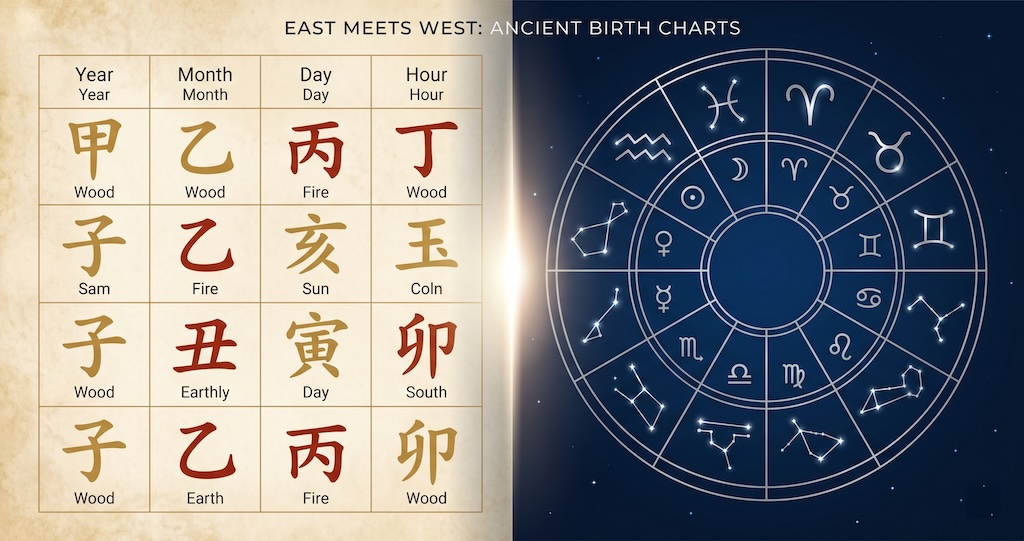
BaZi (Four Pillars of Destiny) and Western astrology are both birth-chart systems that use your date of birth to reveal personality and life patterns, but their frameworks, focal points, and practical uses are very different. Western astrology maps planetary positions onto 12 zodiac signs to describe personality and transits. BaZi maps your birth year, month, day, and hour onto a system of 10 Heavenly Stems and 12 Earthly Branches to analyze character, career, relationships, and timing.
What Is Western Astrology?
Western astrology traces its roots to ancient Mesopotamia and Greece, developed over 2,000 years into a rich system of planetary symbolism. At its core, Western astrology:
- Maps the positions of the sun, moon, and planets at your birth onto the 12 zodiac signs (Aries through Pisces)
- Divides the birth chart into 12 houses, each governing a life domain (identity, money, relationships, career, etc.)
- Interprets aspects — the angles planets form to each other — as harmonies or tensions in your character
- Uses transits (current planetary positions) and progressions to describe timing and life phases
Your sun sign (what most people know) is just the position of the sun at your birth. A full natal chart includes your rising sign, moon sign, and all planetary positions — producing a complex, layered portrait.
Western astrology is deeply embedded in contemporary culture. It has the largest following of any divination system in the Western world, with billions of people aware of their zodiac sign.
What Is BaZi?
BaZi (八字), also called Four Pillars of Destiny, is a Chinese metaphysical system dating back over 1,000 years. Where Western astrology maps planetary positions, BaZi maps your birth data onto a grid of:
- 4 pillars: Year, Month, Day, Hour
- 8 characters (ba zi): Each pillar contains a Heavenly Stem and an Earthly Branch — producing 8 characters total
- The Day Master: The Heavenly Stem of the Day pillar, which represents your core self
- 5 elements: Wood, Fire, Earth, Metal, Water — each element interacting with the others through relationships of generation and control
- 10 Gods: The 10 relational patterns between the Day Master and other elements, mapping your relationships to career, wealth, authority, creativity, and more
- Luck Pillars: 10-year cycles showing major life phases and timing
BaZi is less well-known in the West than Western astrology but is widely practiced across East Asia, particularly in China, Taiwan, Hong Kong, Singapore, and Malaysia.
Key Differences: BaZi vs Western Astrology
| Western Astrology | BaZi | |
|---|---|---|
| Origin | Ancient Greece / Mesopotamia | Tang Dynasty China (~7th century) |
| Core elements | 12 zodiac signs, planets, houses | 5 elements, 10 Heavenly Stems, 12 Earthly Branches |
| Self-representation | Sun sign (solar identity) | Day Master (the self) |
| Life domains | 12 houses | 10 Gods (relational archetypes) |
| Timing | Transits + progressions | 10-year Luck Pillars + annual stems/branches |
| Focus | Character + planetary influence | Character + timing of life events |
| Hour required? | For rising sign and full chart | For full chart (Hour Pillar) |
| Complexity | High (300+ asteroids, aspects, etc.) | High (element interactions, combinations, clashes) |
| Common use | Self-understanding, relationship compatibility, forecasting | Career, wealth, relationship, timing strategy |
What Western Astrology Does Better
1. Personality nuance through archetypes Western astrology's 12 sign archetypes carry centuries of rich symbolic meaning. Aries, Scorpio, Pisces — each brings a vivid, layered picture of personality that many people find deeply resonant. The planetary ruler system (Mars rules Aries, Venus rules Taurus) adds another dimension of nuance.
2. Cultural familiarity In the English-speaking world, Western astrology is the entry point for most people exploring personality systems. The sun sign column is in every magazine; the language is widely shared. This cultural penetration makes Western astrology useful for broad communication.
3. Relationship compatibility framework Western astrology's system of synastry (chart comparison) and composite charts is highly developed. The analysis of how two people's charts interact — which planets form harmonious or challenging aspects — provides detailed relationship analysis.
4. Psychological depth Modern Western astrology has absorbed a great deal of Jungian psychology. Practitioners like Liz Greene and Howard Sasportas developed the psychological astrology tradition, which treats the chart as a map of the unconscious as much as a personality description.
What BaZi Does Better
1. Timing precision BaZi's 10-year Luck Pillars and annual branch analysis offer some of the most precise timing guidance available in any personality system. Rather than vague "you'll experience transformation" language, BaZi can point to specific 10-year windows where particular themes (career breakthrough, relationship shift, wealth accumulation) are likely to activate.
2. Career and wealth analysis BaZi's 10 Gods framework is exceptionally suited to career and financial analysis. The Wealth Star, Resource Star, Officer Star, and others each correspond to specific life domains and describe your relationship to money, authority, and work with great specificity.
3. Practical decision-making BaZi practitioners often use the chart for pragmatic guidance: when to change jobs, when to start a business, when to marry, when to avoid major financial moves. The system is built around helping people navigate timing, not just understand themselves.
4. Element balance The five-element framework in BaZi provides an intuitive sense of where your energy is concentrated and where it's deficient. An excess of Water in the chart might suggest overthinking or fear. A lack of Fire might suggest difficulty with visibility and motivation. These element dynamics map onto both health and psychology.
Similarities Between BaZi and Western Astrology
Despite their different traditions, the two systems share important common ground:
- Both use your birth date (and ideally time) as the foundation
- Both describe personality, tendencies, strengths, and vulnerabilities
- Both offer a framework for understanding relationship compatibility
- Both include a timing dimension that maps life phases and cycles
- Both require a practitioner (or significant study) to interpret with depth and accuracy
- Neither is scientifically validated — both are frameworks for self-reflection and guidance
Which System Should You Use?
Choose Western Astrology if:
- You're new to birth-chart systems and want cultural familiarity
- You're primarily interested in personality and psychological self-understanding
- You want to explore a relationship compatibility framework with a long Western tradition
- You're drawn to symbolic, archetypal thinking
Working with a Western chart and want AI to help interpret it? Start with our ChatGPT astrology prompts — same rule as everywhere on this site: compute the chart first, then let the model interpret.
Choose BaZi if:
- You want precise timing guidance around major life decisions
- You're interested in career and wealth analysis at a specific level
- You're curious about East Asian metaphysics and the five-element framework
- You want a practical tool for navigating life's major crossroads
Use both if: Both systems offer genuine insight. Many people find Western astrology provides the psychological depth and archetypal language, while BaZi provides the timing precision and practical navigation. They complement rather than contradict each other.
FAQ: BaZi vs Western Astrology
Is BaZi more accurate than Western astrology? Neither system is scientifically validated, so "accurate" depends on what you're measuring. Many practitioners and users find BaZi's timing analysis — particularly the 10-year Luck Pillars — to be very precise for major life transitions. Western astrology tends to offer more nuanced psychological portraits. Both are valuable; they just do different things well.
Can your Chinese zodiac sign and Western zodiac sign contradict each other? Yes, and it's common. Someone born in early February might be a Capricorn in Western astrology but a Rat or Ox in the Chinese zodiac, depending on whether the Chinese New Year has occurred. These systems use different frameworks and shouldn't be expected to tell the same story.
Is BaZi the same as Chinese astrology? Not exactly. "Chinese astrology" often refers to the 12-animal Chinese zodiac year system (Rat, Ox, Tiger, etc.), which is much simpler than BaZi. BaZi is a more sophisticated system that incorporates the Day Master, five elements, and 10 Gods — making the 12-animal year just one layer of a much more complex analysis. See What is BaZi for a full introduction.
Do I need my birth time for both systems? Western astrology requires your birth time for an accurate rising sign and full house analysis — without it, much of the depth is lost. BaZi requires your birth time for the Hour Pillar, which adds the fourth column to your chart. Both systems can offer partial analysis without birth time, but the full picture requires it.
How does BaZi compare to Zi Wei Dou Shu (Purple Star Astrology)? Both are Chinese metaphysical systems, but they approach the chart differently. BaZi uses the five elements and 10 Gods; Zi Wei uses a grid of 12 palaces with star placements. Many practitioners in East Asia use both. See BaZi vs Zi Wei Dou Shu for a detailed comparison.
Where can I learn more about BaZi? Start with What is BaZi, then move to How to Read a BaZi Chart and the Day Master Guide. For a free chart analysis combining BaZi, Human Design, and Purple Star Astrology, try The OriCode.